

Be first to read the latest tech news, Industry Leader's Insights, and CIO interviews of medium and large enterprises exclusively from Energy Tech Review
The hydrogen energy industry is rapidly advancing with fuel cells and electrolyzers taking center stage in the clean energy transition. At the core of these systems are flow plates—ultra-thin metal sheets that guide gases and liquids while conducting electricity. Manufacturing these plates has always been a complex task. Balancing gas distribution, conductivity, durability, scalability and cost can affect quality, speed and volume of production. Cell Impact, a premier manufacturer of bipolar plates for hydrogen fuel cells and electrolyzers, overcomes these challenges with its proprietary, high-velocity, dry forming technology. It’s a vast improvement from the multi-step processes used in stamping or hydroforming. The innovative technology produces high-quality flow plates in a single step within shorter timeframes and at a fraction of the traditional production cost. The patented Cell Impact Forming technology can produce complex geometric shapes with remarkable precision while keeping production scalable and energy-efficient. It creates future-ready designs that meet high-quality standards and include features competitors cannot replicate. It is the only working cost-efficient solution on the market today that is aligned with the future high volume targets of cost and quality for 2030. Cell Impact’s facility in Karlskoga, Sweden houses a large inventory of ready-to-market products. “Our bipolar plate forming technology pushes the limits of what is formable to enable performance levels clients cannot achieve using other methods,” says Daniel Vallin, CEO. Backed by years of engineering expertise and extensive testing, Cell Impact serves as a flow plate supplier and a provider of plate manufacturing processes for its clients. Its high-volume production capabilities, state-of-the-art leak testing and advanced measurement instruments for evaluating plate and forming tool dimensions make it the partner of choice for clients. High-Speed Forming with Performance, Precision and Flexibility Cell Impact’s technology combines the reliability of conventional methods with proprietary innovations that boost speed and material flexibility. Its speed-based approach stands in stark contrast to the force-based stamping and hydroforming methods. Despite the widespread use of these techniques, persistent limitations remain. Conventional stamping ensures stability within flow plates, but it comes with limited flexibility and lower production speed. Hydroforming is capable of creating complex geometries and enhancing plate strength. But it often struggles to meet commercial production needs, making it more suitable for prototypes or low-volume runs. The Cell Impact Forming technology ensures high-performance flow plates that consistently meet volume requirements with shorter lead times.
Top Green Energy Equipment Infrastructure Solution in Europe 2025
Greece is heading toward a sustainable future with expertly crafted, advanced technologies and innovative solutions. With this development, creating resilient energy networks has never been easier for infrastructure operators, energy developers and technology partners. Climergia is at the forefront of this sustainable energy innovation. Driven by a mission to enable renewable energy transition through integrated, responsible infrastructure, it provides green energy equipment and exceptional consulting services. Operating as an end-to-end solutions integrator, Climergia manages the full process—from supplier coordination and compliance to delivery and integration—bridging international manufacturers with European developers, investors, EPC contractors and energy operators. This role as a project orchestrator ensures seamless implementation and lasting performance across every green equipment it delivers. Climergia’s equipment offerings are shaped by close collaborations with selected manufacturers in Europe and Asia who invest heavily in R&D and certification. The portfolio includes substations, switchgear, transmission lines and power cables, steel towers, energy storage systems and EV chargers, covering the full spectrum of modern energy needs. Climergia’s strength lies in combining technical precision with a partnership mindset. Guided by this approach, it provides systems that support renewable generation and strengthen resilience and efficiency across the grid. “We don’t simply supply equipment,” says Anastasia Pappa, operations director. “We help our clients shape reliable, future-ready energy systems.” Building on the strong foundation of reliability and precision, Climergia evolves with the market shift. Energy storage systems and EV charging facilities are currently growing at breakneck speeds, driven by renewable integration and the upsurge in electric mobility. Climergia’s modular energy storage solutions integrate advanced Energy Management Systems (EMS) and grid-forming inverter technology to stabilise frequency, balance intermittent renewable generation, and enhance overall grid flexibility. These scalable systems enable clients to expand capacity seamlessly without compromising stability, interoperability or cost efficiency. Its EV charging solutions provide scalable infrastructure that supports the transition to cleaner transportation..

Energy Storage Solution

Hitting the energy efficiency bull’s eye for cleaner and greener operations is no longer a distant goal. In the modern energy landscape, where technological advances meet global urgency, E-Storage Engineering has created a foothold in storage systems as a specialist in electrochemical solutions. By integrating innovations with a forward-thinking approach, it delivers advanced, long-term energy storage solutions to various industries. E-Storage Engineering is the only design company in Italy that has adopted an engineering systems methodology for energy storage development. Its reputation has attracted collaborations with prestigious institutions like MIT and leading researchers worldwide. The company’s engineering principles are also applied through spin-off consultancy, which offers expert guidance to customers on implementing electrochemical energy systems. Working with university offshoots, utility companies and multinational corporations, E-storage Engineering is pivotal in driving the new era of energy adoption across Europe and beyond. A Tale of Transformation E-Storage Engineering’s genesis was driven by Dr. Massimo Guarnieri’s transition from a successful career in nuclear fusion engineering to more accessible facets of the energy sector. Having spent decades in magnetic confinement research, he sought a new path that led him to electrochemical energy systems. Guarnieri’s journey expanded to include lithium-ion batteries and, eventually, flow batteries, which have since become central to E-Storage Engineering’s operations. A defining moment was the creation of an engineering-centric framework for energy storage, a rare approach in a field dominated by chemistry-focused, small-scale systems. “We understood that developing scalable energy solutions required an engineering approach that goes hand-in-hand with chemistry advancement,” says Guarnieri. Today, E-Storage Engineering integrates diverse specialities, including electrical, mechanical, energy and chemical engineering, each contributing to creating technologies for various applications, from mobile energy storage to large-scale grid solutions.
CXO INSIGHTS

The Root of Sustainable Energy Sourcing
Justin Tait, Senior Director, Sustainability, Enviva

Technical-Economic efficiency, a question of the market
Miguel Angel Hidalgo Gonzalez, Senior Director of Engineering - North of Europe, EDP Renewables

Scaling up in the Energy Sector: Challenges and Opportunities Ahead
Mark Schaefer, Senior Program Manager Digitalization, Siemens Energy

Ushering in a New Era of Renewable Energy
Tryggvi Thor Herbertsson, Global Head of Hydrogen Strategy and Partnership, QAIR Group

Building VPPS: From Reactive Services to Strategic Foresight
Mark Meyrick, General Manager, Ecotricity Smart Grid Limited

Green Hydrogen Enters the Game of Heating
Arnt Baer, Managing Director, Gelsenwasser

Rethinking GDPR Sustenance
Christos Syngelakis, Group Chief Information Security Officer (CISO) and Data Protection Officer (DPO), Motor Oil


IN FOCUS

Industrialising Hydrogen: Capitalising on Europe's Flow Plate Supply Chain
Europe's shift to mass manufacturing for hydrogen technology centres on bipolar flow plates, advancing precision and efficiency through high-speed forming and surface engineering, crucial for gig.
CapEx Flows and the Rise of Energy Infrastructure Manufacturing
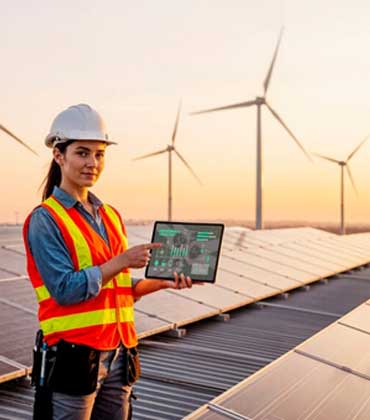
The European energy sector is evolving with increased investment in local industrial ecosystems, focusing on renewable manufacturing, infrastructure, and technology to enhance energy security and resilience.
EDITORIAL
Innovation and the New Blueprint for Clean Energy Scale
As 2025 draws to a close, Europe’s clean energy sector moves beyond its pitch deck era. Technologies that spent a decade in demonstration projects are now manufactured at industrial scale and procurement commitments carry weight across the continent.
Hydrogen fuel cells are crossing a genuine commercialisation threshold. Progress stems from materials engineering, which rarely receives attention. Lightweight composite bipolar flow plates with advanced coatings and precision manufacturing now withstand continuous duty cycles in heavy transport and industrial heat. European steelmakers and logistics operators begin to integrate hydrogen not as a pilot but as infrastructure.
Renewable installations shift from standalone assets to networked intelligence layers. AI driven monitoring and predictive maintenance transform solar, wind and storage systems into self optimising entities that autonomously manage variability. Grid operators from Iberia to the Nordics no longer scramble to balance intermittent energy sources. They dispatch renewables as baseload with a level of confidence that would have sounded reckless three years ago.
Market momentum supports this shift. Europe’s hydrogen economy is projected to reach £4.8 billion by 2033 at a compound annual growth rate of 16.7 per cent, while green energy infrastructure solutions across the EU and UK track towards £1.8 trillion at 9.2 per cent.
Clean energy enters 2026 in a different posture. It is engineered, financed and installed faster than permitting can keep pace. The only question now focuses on deployment velocity.
The magazine features thought leadership articles from Antony White, Client Delivery Manager at UK Power Networks Services and Leslie Myers, Product Manager, Renewables at Puget Sound Energy.
We also spotlight innovators pushing hydrogen technology towards industrial scale. One such company, Cell Impact, is redefining what high performance flow plates can deliver through its patented high speed forming technology, offering precision and cost efficient scalability.
We hope this edition offers insights for hydrogen technologists, OEM leaders and energy transition decision makers working to scale clean power systems with greater precision. In a sector where engineering rigour defines competitive advantage, this issue celebrates the innovators turning advanced manufacturing and sustainable design into real progress for the hydrogen economy.
