

Be first to read the latest tech news, Industry Leader's Insights, and CIO interviews of medium and large enterprises exclusively from Energy Tech Review
A featured contribution from Leadership Perspectives, a curated forum for energy technology leaders nominated by our subscribers and vetted by the Energy Tech Review Editorial Board.

.
The Chicken and the Egg Problem
.
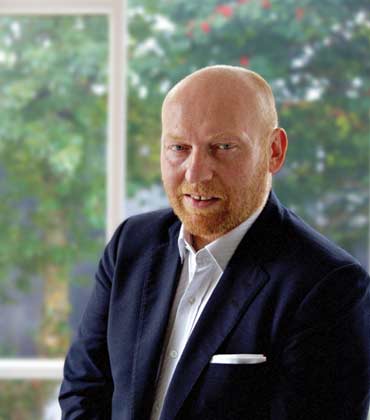
Dr Tryggvi Thor Herbertsson is the chairman of Qair Iceland H2 and the head of the Hydrogen Strategy and Partnership of the Qair Group. He is also the Founder and Chairman of Taurus SLF, a corporate and investment advisory firm. He served as a Member of Parliament in Iceland, a Special Economic Advisor to the Prime Minister during the 2008 financial crisis, and CEO of Askar Capital. He has also been a consultant to major international organisations, including the World Bank, International Monetary Fund (IMF) and Organisation for Economic Cooperation and Development (OECD).
Through this article, Dr Tryggvi Thor Herbertsson emphasises the potential of green molecules, particularly green ammonia, as a sustainable energy carrier. He also highlights the advantages of green molecules over electricity, such as their ability to be transported over long distances and their potential to connect remote production areas to main consumption markets.
The Qair Group has over 25 years of experience as a renewable IPP. The Group currently has around 1,400MW in operations, 450MW under construction, as well as a pipeline of around 35GW of renewable projects across the world. This puts the company in an advantageous position to produce green molecules (green hydrogen and its derivatives) – using its renewable power. The Group is currently developing green molecules projects in France, Iceland, and Brazil, targeting 3GW of electrolysis by 2032, including 2GW in Brazil.
“On a more modest scale, land mobility where batteries are suboptimal due to weight and endurance, i.e., public transport and trucking, also shows potential. This sector is rather easy to address with smaller projects.”
One of the advantages of green molecules is their ability to carry energy over space and time, but electricity cannot extend beyond the grid boundaries. This allows us to connect remote favourable hydrogen production areas to main consumption markets, which in the case of green molecules rarely overlap. For instance, the recent auctions launched by Total (refining optimization), Salzgitter, and Thyssenkrupp (both green steel production) point to northern Europe as one of such demand hubs, while Leveraged Cost of Hydrogen (LCOH) in the region is hardly competitive.
All green molecules are not created equal; at the moment, green ammonia is generally considered the most economical and practical hydrogen carrier for shipping over long distances. Far beyond green hydrogen itself. However, this adds an extra layer of challenges to most large-scale green hydrogen production projects as it requires cracking back into hydrogen and injection into a pipe down to the end-user (CIF delivery). This turned out to be the case in the aforementioned auctions. These additional steps incur additional costs and higher prices. However, this is not necessarily prohibitive should the local LCOH be sufficiently low. Unfortunately, though, neither the crackers nor the pipelines are ready, and investment decisions keep being delayed.
On a longer time horizon than green steel mills and refineries, the maritime sector offers very promising offtake perspectives. Large shipping companies like Maersk, CMB, and Trafigura have been placing orders for dual-fuel engine ships where ammonia is burned directly – a few of which shall be operational in the near future. In this offtake scenario, FOB delivery would be a realistic and effective way to minimize CAPEX, circumvent logistic hurdles, and reduce the need for guarantees down the logistic chain. In light thereof, Katanes, the Group’s ammonia giga-project in Iceland, intends to position itself partly in this segment.
On a more modest scale, land mobility where batteries are suboptimal due to weight and endurance, i.e., public transport and trucking, also shows potential. This sector is rather easy to address with smaller projects. Consequently, the Group has been developing distribution Hydrogen Refueling Station (HRS) networks powered by its production facilities in Occitanie (Southern France) and around Iceland (two stations already operational in the vicinity of Reykjavik).
When it comes to green molecules, no matter the segment, any large-scale offtake contract is a conundrum. Off-takers are reluctant to commit or to make compromises on their sourcing terms and conditions. But with few offtake agreements in sight, new independent hydrogen projects, albeit sometimes very promising, are not deemed bankable which hinders their development and delays their investment decision. Hopefully, aside from the aforementioned auctions for green steel and refineries, the European Hydrogen Bank, H2Global, and recently the new Dutch hydrogen auctions will break this chicken and egg circularity, by providing reliable and accessible offtake solutions – thus speeding up investment decisions. But until then, we will probably not see the construction of large-scale projects from independent hydrogen producers.
The articles from these contributors are based on their personal expertise and viewpoints, and do not necessarily reflect the opinions of their employers or affiliated organizations.
